For decades, the standard solar panel has been a "one-sided" affair. We looked at the dark, glass-covered front as the engine and ignored the back, which was typically finished with an opaque white or black backsheet. This made sense when panels were expensive and efficiency was a struggle; we just wanted to catch the direct light from the sun. But as the cost of silicon has plummeted and the engineering has become more sophisticated, a "two-faced" revolution has taken over the utility-scale market and is now creeping onto residential rooftops.
The question at the heart of this shift is simple: Do bifacial solar panels really produce more energy, or is it just a clever marketing gimmick designed to justify a higher price tag? To find the answer, we have to look past the sales brochures and dive into the physics of light, the chemistry of the cells, and the harsh reality of installation geometry.
At its most basic level, a bifacial solar panel is exactly what it sounds like. Instead of an opaque backsheet, the panel uses a clear material—usually glass, but sometimes a transparent polymer—on the rear. This allows the solar cells to capture light from both directions.
However, it is not as simple as just flipping the panel over. The cells themselves must be designed to be bifacial. In a standard monofacial cell, the back is covered with a solid aluminum contact that blocks light. A bifacial cell replaces that solid slab with a finger-grid of metal, similar to what you see on the front. This allows photons to enter from the rear and kick off the photoelectric effect just as effectively as they do on the front side.
When we talk about energy production, we have to consider three sources of light:
It is this third category—Albedo—that determines whether a bifacial panel is a brilliant investment or a wasted expense.
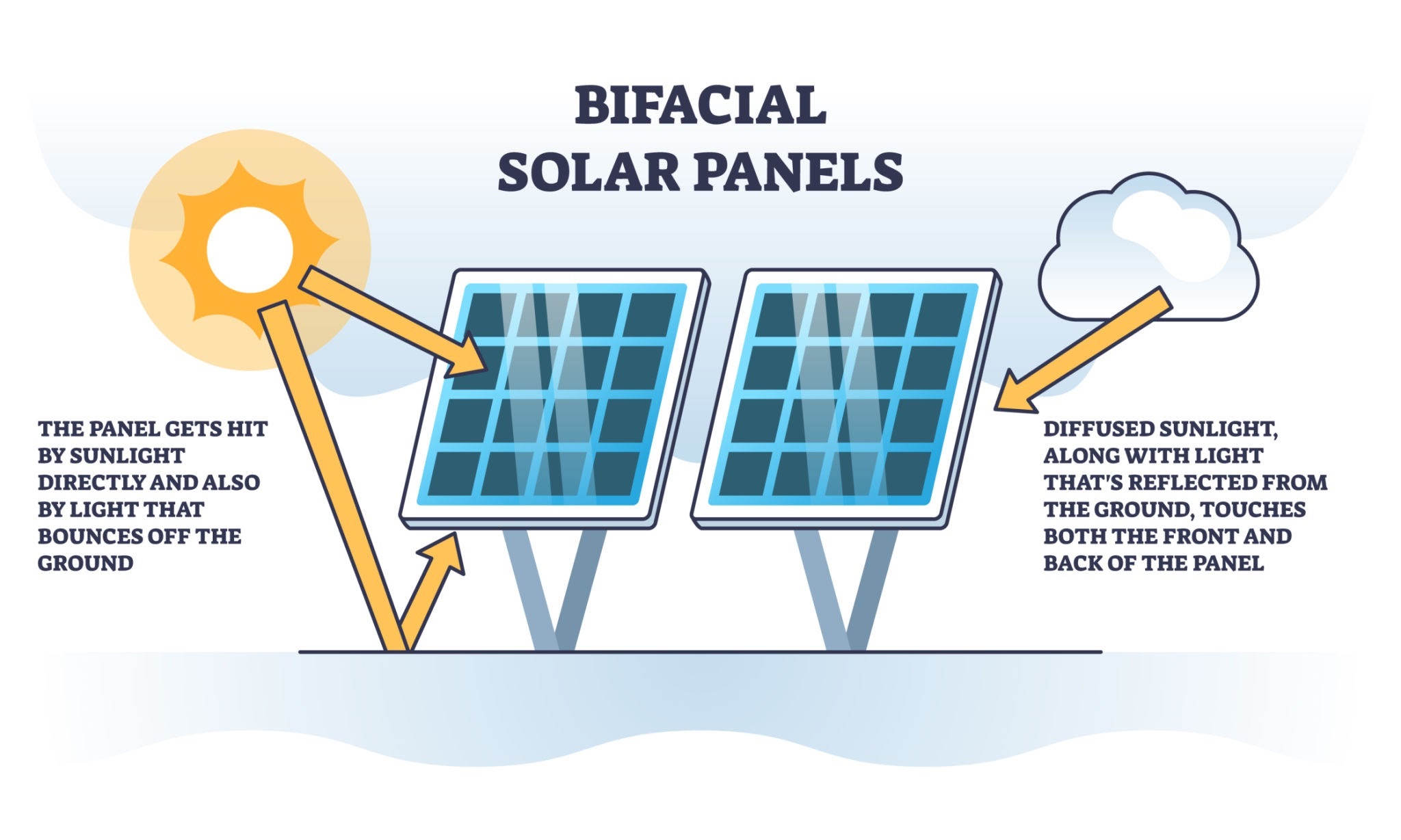
The performance of a bifacial panel is inextricably linked to the surface it sits above. This is measured by the albedo coefficient, which represents the reflectivity of a surface. A surface with an albedo of 0 absorbs all light; a surface with an albedo of 1.0 reflects all of it.
If you install a bifacial panel over a dark, asphalt roof, the albedo might be as low as 0.05 (5%). In this scenario, the "bifacial gain"—the extra energy produced by the back side—will be negligible. You might see a 1% or 2% boost, which likely won't cover the extra cost of the equipment.
However, if that same panel is installed over a white TPO roof, light-colored gravel, or—best of all—fresh snow, the albedo can jump to 0.80 (80%). In these high-reflectivity environments, the back side of the panel can contribute a massive amount of power. It is not uncommon for utility-scale projects in snowy regions or desert sands to see a total energy boost of 20% to 30% over monofacial equivalents.
Not all bifacial panels are created equal. Engineers use a metric called the Bifaciality Factor to describe how efficient the back of the panel is compared to the front.
In a perfect world, the factor would be 1.0 (100%), meaning the back produces exactly as much power as the front. In the current market, however, the back side is usually slightly less efficient due to the shading from the rear metal grid and the way the silicon is "doped" during manufacturing.
Ptotal=Pfront+(Prear×Bifaciality Factor)
For standard P-type PERC (Passivated Emitter and Rear Cell) panels, the bifaciality factor usually hovers around 65% to 75%. Newer N-type technologies, like TOPCon (Tunnel Oxide Passivated Contact) and HJT (Heterojunction Technology), have pushed this significantly higher, often reaching 85% to 95%. This means that for every 100 watts the front produces, the back could potentially produce another 95 watts if the light was bright enough.
A bifacial panel shoved flat against a roof is just a very expensive monofacial panel. To get the "gain," the panel needs room to breathe—metaphorically and optically.
In 2026, the industry has largely moved away from the older P-type silicon that dominated for decades. The reason? P-type silicon is prone to Light-Induced Degradation (LID) and has a lower ceiling for bifacial efficiency.
N-type TOPCon has become the new industry workhorse. It offers better performance at high temperatures and a much higher bifaciality factor than the PERC panels of the early 2020s. But the real star for bifaciality is Heterojunction (HJT) technology. HJT cells are naturally symmetrical. Because the manufacturing process is almost identical for the front and back of the cell, HJT panels often boast bifaciality factors above 90%.
These high-efficiency cells also perform better in low-light and diffuse-light conditions. On a cloudy day, when there is no "direct" sun, a bifacial HJT panel is still busy harvesting the "glow" from the entire sky on both sides. This makes the energy production curve much flatter and more predictable throughout the day.
The most effective way to use a bifacial panel is to put it on a tracker. Single-axis trackers follow the sun from east to west throughout the day. When you combine trackers with bifacial panels, you create a "compounding interest" effect for energy production.
As the tracker tilts the panels, it exposes more of the ground underneath to direct sunlight. That sunlight then reflects back up into the rear of the tilted panels. This creates a feedback loop where the system is constantly optimizing its angle to catch both the direct rays on the front and the reflected rays on the back. Studies have shown that a tracking bifacial system can produce up to 35% to 40% more total energy than a fixed-tilt monofacial system of the same nameplate capacity.
Does it really produce more energy? Yes. But the better question is: Does it produce energy more cheaply?
In the energy industry, we use the Levelized Cost of Energy (LCOE) to determine the viability of a project. LCOE is the total cost of building and operating a system divided by the total energy it will produce over its lifetime.
For utility-scale developers, the math is almost always in favor of bifacial. Even a 5% increase in energy yield usually justifies a 10% increase in upfront hardware costs because that extra energy is harvested every single day for thirty years. For residential users, the math is murkier. If you have a dark shingle roof, bifacial is likely not worth it. If you have a flat, white roof or a ground mount in a snowy area, it’s a no-brainer.
One of the secondary benefits of bifacial panels that often gets overlooked is their longevity. Most bifacial panels use a "glass-glass" construction (dual-glass).
Standard panels with a plastic backsheet are susceptible to moisture ingress over time. The backsheet can crack, yellow, or delaminate after twenty years of exposure to UV radiation and temperature swings. Glass, however, is chemically inert. It doesn't yellow, and it provides a much better seal against moisture.
This is why many bifacial panels come with 30-year performance warranties, whereas 25 years used to be the industry limit. When you factor in an extra five years of production, the "total energy" story becomes even more lopsided in favor of bifaciality.
Aside from the technical specs, bifacial panels have changed the look of solar. Because they are transparent, they have a sleek, modern aesthetic. When used on pergolas, carports, or awnings, they provide "dappled" shade rather than the total darkness of a standard panel. This makes them a favorite for architects who want to integrate solar into the structure of a building rather than just bolting it on top.
Imagine a backyard patio cover made of bifacial panels. You get a shaded area to sit, the panels produce power from the sun above, and they pick up reflected light from your patio stones below. It turns a passive structure into an active power plant without looking like an industrial eyesore.
A common concern is whether bifacial panels require twice the maintenance. If the back side is covered in dust or bird droppings, does the gain disappear?
The reality is that the back side of the panel stays much cleaner than the front. Gravity is your friend here; dust doesn't settle on the underside of a tilted panel as easily as it does on the top. Furthermore, rain doesn't wash dirt onto the back side. In most environments, the rear glass remains remarkably clear for years. While you should still clean your panels periodically, the "back-side maintenance" is usually a non-issue.
So, back to our central question: Do they really produce more energy?
The data from thousands of monitored sites worldwide says a resounding "Yes." However, that "Yes" comes with a condition: If the environment allows it.
A bifacial panel in a "monofacial environment"—flat on a black roof—is like buying a sports car to drive in a school zone. It will work, but you are wasting the potential. But in the right conditions—elevated, tilted, and over a reflective surface—bifacial panels are the most efficient way to harvest solar energy.
As we move deeper into 2026, the "bifacial vs monofacial" debate is slowly becoming obsolete. Bifacial technology is becoming the baseline standard. The industry has realized that capturing the light we used to throw away is the easiest path to a lower carbon footprint and a lower electricity bill. Whether you are a utility developer or a homeowner, the era of the "one-sided" panel is coming to an end. The future of solar is, quite literally, looking at both sides now.

 Call us : +86 13905633017
 Mail us : info@hssolar.com
 Add : Industrial Zone, Ningguo, Xuancheng, China
 Support for IPv6 networks