
Solar Roof Mount vs Ground Mount: Pros, Cons, and Installation Costs
Choosing between a solar roof mount and a ground mount comes down to four practical variables: available property space, upfront installation budget, roof condition, and long-term electricity goals. For most residential homeowners with an unshaded, structurally sound roof, roof-mounted solar delivers the lowest upfront installation cost and the fastest permitting timeline. For properties with open acreage, shaded or aging roofs, or higher electricity demands, ground-mounted solar produces more kilowatt-hours per installed kilowatt, simplifies ongoing maintenance, and scales without structural constraints.
Both mounting approaches rely on the same core photovoltaic modules and inverters, yet the structural engineering, site preparation, thermal behavior, and lifecycle economics differ substantially. Understanding how each racking architecture performs over a 25- to 30-year operating lifespan helps property owners, facility managers, and project developers avoid costly redesigns and maximize energy return.
How Roof-Mounted and Ground-Mounted Solar Systems Work
Roof-mounted solar systems attach directly to the existing structure of a home, warehouse, or commercial building. On pitched asphalt shingle or tile roofs, installers anchor corrosion-resistant anodized aluminum rails into wooden rafters using lag bolts sealed with waterproof metal flashings. Solar panels clamp onto those rails roughly 3 to 6 inches above the roof surface, leaving a narrow channel for drainage and air circulation. On standing-seam metal roofs, non-penetrating clamps grip the raised metal seams without drilling holes through the decking. On flat commercial roofs, crews typically install weighted ballasted racking trays held down by concrete blocks at a low 5- to 10-degree tilt, protecting the waterproof roof membrane from penetrations.
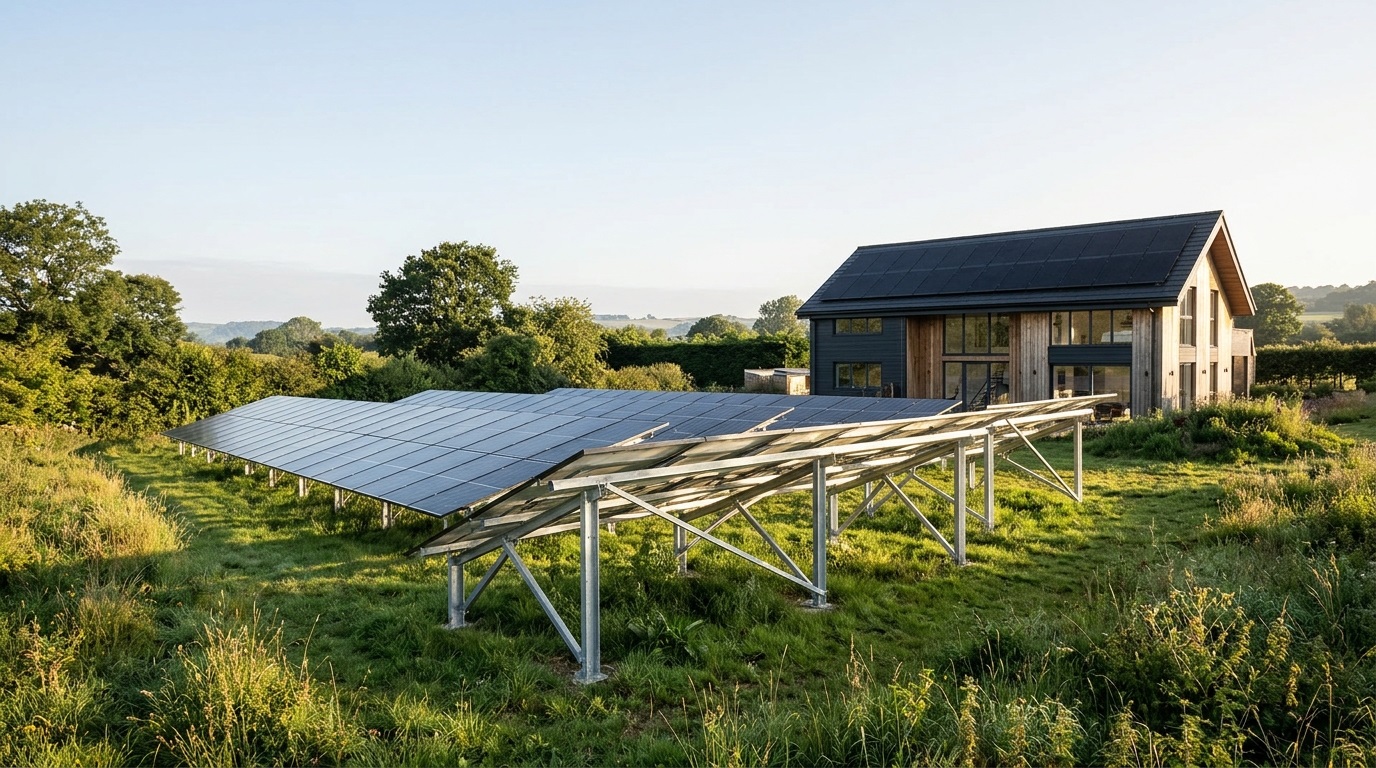
Ground-mounted solar systems are freestanding structures built directly on open land. Standard fixed-tilt ground racks use galvanized steel I-beams, C-channels, or helical piles driven 5 to 10 feet into the soil with hydraulic pile drivers. Where shallow bedrock, loose sand, or high water tables prevent driven posts, contractors pour reinforced concrete piers or install heavy surface-ballasted frames. Horizontal steel or aluminum purlins span the vertical posts to support rows of solar modules 3 to 6 feet above ground level. Direct-current or alternating-current wiring runs from the array through underground trenched conduit back to the building’s main electrical service panel.
Solar Roof Mount vs Ground Mount Costs
Upfront pricing is the sharpest dividing line between rooftop and ground-mounted arrays, though project scale heavily influences which option costs less per watt.
For residential installations, roof-mounted solar typically costs between $2.50 and $3.30 per watt before tax credits or local incentives. A standard 10 kW residential rooftop system generally lands between $25,000 and $33,000 gross. Because the building already provides the supporting structure, racking hardware and structural mounting labor represent a modest portion of total project expenses, and wiring runs from the roof to the electrical panel remain short.
Residential ground-mounted solar usually adds $0.30 to $0.80 per watt compared to an equivalent rooftop array, placing total gross installation costs between $3.00 and $4.00 per watt, or roughly $30,000 to $40,000 for a 10 kW system. Several site-specific requirements drive that premium:
- Foundation and steel work: Heavy-gauge galvanized steel posts, wind-bracing struts, and concrete footings cost significantly more than lightweight aluminum roof rails and flashings.
- Trenching and long wire runs: Excavating a 50- to 200-foot trench for underground conduit and upsizing copper or aluminum conductors to prevent voltage drop adds equipment and labor hours.
- Site preparation: Clearing brush, grading uneven slopes, and conducting soil pull-tests add soft and civil engineering costs before panel installation begins.
At commercial, agricultural, and utility scales above 100 kW, those economics flip. Ground-mounted solar becomes cheaper per watt than commercial rooftop installations because crews can drive steel piles across open land rapidly with heavy machinery, avoid crane lifts and rooftop fall-protection rigging, and deploy large-format, high-wattage modules without worrying about roof dead-load limits.
Long-term ownership costs also deserve careful attention. Quality solar panels operate reliably for 25 to 30 years or more, while a standard asphalt shingle roof lasts 20 to 25 years. Installing rooftop solar on shingles that are already 12 to 15 years old almost guarantees paying $3,000 to $6,000 later to detach, store, and reinstall the array when the roof needs replacement. Ground-mounted arrays eliminate reroofing expenses entirely.
Pros and Cons of Roof-Mounted Solar
Roof-mounted racking remains the dominant choice for suburban homes and urban commercial buildings because it turns otherwise idle surface area into clean power generation.
Advantages of Roof-Mounted Solar:
- Lower residential upfront investment: Eliminating ground foundations, structural steel posts, and trenching keeps initial capital requirements lower and shortens simple payback timelines.
- Zero land footprint: Panels occupy existing roof planes, leaving backyards, gardens, pastures, driveways, and commercial parking lots completely undisturbed.
- Faster local permitting: Most municipal building departments maintain standardized permitting checklists for flush-mounted residential solar, and solar access laws in many regions prevent homeowners associations from blocking reasonable rooftop installations.
- Passive cooling for the building: Shading the roof deck from direct afternoon sunlight reduces heat transfer into upper floors and attics during peak summer months.
Drawbacks of Roof-Mounted Solar:
- Fixed tilt and compass orientation: Rooftop panels must follow the existing slope and direction of the roof. Buildings with steep north-facing roofs, awkward hip-roof geometry, or heavy shading from neighboring trees suffer lower annual production.
- Higher panel operating temperatures: Limited airflow beneath flush-mounted panels traps heat against dark shingles. Crystalline silicon solar cells lose roughly 0.3% to 0.4% of their power output for every degree Celsius above 25°C, reducing efficiency on hot summer afternoons.
- Size and structural weight caps: Dormers, skylights, plumbing vents, and mandatory fire-code perimeter setbacks shrink usable roof area, while older rafters may require structural reinforcement before carrying snow and wind loads.
- Difficult access for cleaning and repairs: Inspecting wiring, replacing a failed module-level inverter, or clearing heavy winter snow requires ladders and roof safety harnesses.
Pros and Cons of Ground-Mounted Solar
Ground-mounted racking prioritizes energy yield, mechanical accessibility, and system longevity over minimum initial hardware cost.
Advantages of Ground-Mounted Solar:
- Ideal tilt angle and sun alignment: Installers can orient ground racks due south in the Northern Hemisphere—or due north in the Southern Hemisphere—and set the exact latitude-optimized tilt angle to maximize year-round kilowatt-hour generation.
- Cooler cell temperatures and higher energy yield: Unrestricted ambient airflow beneath elevated panels dissipates heat effectively, typically yielding 5% to 10% more annual electricity per installed kilowatt than an identical flush-mounted rooftop system in warm climates.
- Support for bifacial modules and solar trackers: Open rear clearance allows bifacial glass-on-glass solar panels to harvest sunlight reflected off light gravel, grass, or winter snow. Ground foundations also support single-axis or dual-axis tracking frames that follow the sun across the sky, boosting annual output by 15% to 35%.
- Effortless ground-level maintenance: Property owners and technicians can rinse dust or pollen with a garden hose, clear snow safely with a soft foam rake, and inspect junction boxes or string inverters while standing firmly on the ground.
- Straightforward expansion: System size is never restricted by roof square footage, making it simple to add extra rows later when adding electric vehicles, heat pumps, workshop machinery, or irrigation loads.
Drawbacks of Ground-Mounted Solar:
- Higher starting price on smaller systems: Concrete piers, structural steel framing, and underground trenching raise initial installation costs for residential-scale arrays.
- Significant land consumption: While a 10 kW array requires roughly 500 to 650 square feet of physical panel area, ground-mounted rows need open spacing between racks so winter shadows from front rows do not fall onto rear rows. In practice, a ground mount occupies 1.5 to 2.5 times its collector area.
- Stricter zoning and setback approvals: Local zoning ordinances often classify ground arrays as accessory structures subject to property-line setbacks, lot-coverage limits, maximum height caps between 8 and 15 feet, and occasional stormwater runoff reviews.
How to Choose Between Roof and Ground Mounting
Selecting the right mounting system becomes straightforward when you evaluate your site against four practical criteria:
- Roof age, material, and shading: If your roof is less than 10 years old—or built with long-lasting standing-seam metal or concrete tile—and has an unshaded south-, east-, or west-facing plane large enough for your energy target, roof mounting offers the strongest financial return. If your roof is nearing replacement or shaded by mature trees, a ground mount avoids costly future removal fees.
- Available open land and soil conditions: Properties with at least a quarter-acre of open, sunny, reasonably level land free of shallow bedrock or buried utilities can accommodate a ground-mounted array without compromising yard usability.
- Current and future electricity demand: Households or businesses planning to electrify heating, expand vehicle fleets, or install high-capacity battery banks benefit from the higher per-kilowatt yield and modular expandability of ground racking.
- Local permitting and visual preferences: In dense suburban neighborhoods with strict setback boundaries, rooftop solar clears municipal review quickly and sits neatly along the roofline. On rural acreage, farms, commercial campuses, and industrial facilities, ground-mounted solar delivers superior energy production and hassle-free maintenance over three decades of service.
Evaluating roof longevity alongside site shading and long-term power consumption ensures your solar investment stays productive, safe to maintain, and cost-effective for decades.
Need Technical Specs or Factory Pricing?
Talk directly with Homesun engineers for module datasheets and turnkey BOM proposals.