
Bigger Solar Panels: Do Larger Modules Actually Mean More Power?
Yes, bigger solar panels generally produce higher peak wattage because a larger surface area captures more incoming sunlight, but physical size is only one factor behind actual electricity generation. A panel’s conversion efficiency, silicon cell architecture, temperature behavior, and inverter compatibility determine how much usable power it delivers per square meter over its operating life. Expanding a panel’s frame raises its rated output on paper, yet larger dimensions also introduce higher electrical currents, heavier structural loads, and tighter installation constraints.
For property owners, EPC contractors, and solar buyers comparing residential modules against commercial or utility-scale panels, understanding the relationship between physical footprint and electrical output prevents costly design mismatches. Looking closely at how manufacturers scale module wattage reveals when bigger panels save money and when compact, high-density modules perform better.
How Physical Surface Area Drives Nameplate Wattage
Solar panels are rated under Standard Test Conditions, an industry benchmark defined as 1,000 watts of solar irradiance per square meter at a cell temperature of 25 degrees Celsius. Under these controlled laboratory conditions, a module’s rated wattage depends directly on two variables: how much surface area is exposed to light and what percentage of that light the photovoltaic cells convert into direct current electricity.
When cell efficiency stays constant, increasing the active glass area raises the nameplate wattage in direct proportion. A standard residential panel built with 108 half-cut cells measures roughly 1.72 meters long by 1.13 meters wide, covering about 1.95 square meters and producing between 410W and 450W. By contrast, a large utility-scale module built with 132 half-cut cells on larger wafers can measure 2.38 meters long by 1.30 meters wide, spanning roughly 3.10 square meters and reaching 680W to 720W.
Much of that jump from 430W to 700W comes simply from spreading more silicon across a wider frame. Put two residential panels side by side and their combined surface area and power output match or exceed a single oversized utility module. Size increases power per individual unit, not necessarily power per square meter of available roof or land.
Conversion Efficiency vs. Panel Size: Why Power Density Matters
Conversion efficiency measures how effectively a solar panel turns sunlight hitting its surface into electrical energy. In commercial production, mainstream P-type PERC modules typically achieve efficiencies between 20.5 percent and 21.5 percent, while modern N-type TOPCon and heterojunction modules reach between 22.0 percent and 23.8 percent.
This distinction matters because higher efficiency boosts power output without requiring extra physical space. Consider two panels that both measure 1.95 square meters. One uses 20.5 percent efficient cells and delivers roughly 400W, while the other uses 23.1 percent efficient N-type cells and delivers 450W within the exact same footprint. Across a twenty-panel residential array, that efficiency advantage yields an extra kilowatt of capacity without adding a single square centimeter of racking, glass, or roof penetration.
Power density becomes critical wherever installation area is capped. Pitched home roofs broken up by dormers, vents, chimneys, and setback rules rarely offer uninterrupted expanses of open space. In those environments, squeezing higher wattage out of a compact footprint beats buying oversized panels that cannot fit cleanly around roof obstacles.
How Larger Silicon Wafers Reshaped Modern Module Dimensions
Over the past decade, solar manufacturers steadily increased module dimensions by enlarging the underlying silicon wafers sliced from monocrystalline ingots. Older residential panels relied on 156.75mm and 166mm square wafers, which kept module lengths near 1.65 to 1.75 meters and power ratings between 300W and 380W.
As manufacturing lines upgraded to 182mm (M10) and 210mm (G12) wafers, individual solar cells gained substantially more light-absorbing surface area. To prevent the higher electrical current from causing excessive resistive heat loss inside the module, engineers paired larger wafers with half-cut and third-cut cell layouts alongside multi-busbar ribbons. Splitting each full wafer into smaller segments halves the current flowing through each cell string, cutting internal resistance losses by roughly three-quarters and improving shade tolerance across the lower and upper halves of the panel.
Rectangular wafer formats, such as 182mm by 191.6mm and 182mm by 210mm cells, further allowed manufacturers to fine-tune module width around 1.134 meters while extending module length to 2.27 or 2.38 meters. That standardization maximized shipping container density while pushing utility-grade module ratings past 600W and 700W.
Electrical, Structural, and Handling Trade-Offs of Oversized Modules
While large-format modules reduce the total number of panels needed to reach a target megawatt capacity, scaling up physical dimensions introduces engineering trade-offs that directly affect system safety, hardware selection, and labor costs.
Higher Operating Current and Inverter Compatibility
Enlarging a solar cell increases its operating current rather than its voltage. While a standard 182mm half-cut module typically operates at a maximum power current around 13 amps, a 210mm half-cut module can push operating current to 17 or 18 amps, with short-circuit currents exceeding 18.5 amps.
If an oversized panel is paired with a string inverter or microinverter whose maximum power point tracking input is capped at 13 to 15 amps, the inverter cannot process the excess current during peak midday sun. The resulting current clipping shaves off the top of the daily production curve, wasting the extra wattage paid for in the larger panel. Before specifying high-wattage modules, system designers must verify that inverter input current ratings comfortably exceed the panel’s maximum power current across cold, high-irradiance conditions.
Wind Uplift, Snow Loads, and Glass Deflection
A solar panel acts like a rigid sail mounted above a roof or tracker torque tube. As length and width expand, total wind uplift pressure and accumulated snow weight multiply across the glass surface. Longer spans between mounting rails also experience greater center deflection under heavy loads, which can induce microcracks in brittle silicon wafers if the frame lacks sufficient stiffness.
To protect oversized modules, manufacturers use thicker anodized aluminum profiles and increasingly rely on dual-glass construction, sandwiching the cells between two sheets of 2.0mm heat-strengthened glass instead of a single 3.2mm glass sheet and polymer backsheet. Even with reinforced frames, large modules often require third-rail support or stricter clamp zone tolerances in coastal hurricane zones and heavy-snow regions.
Weight and Rooftop Installation Logistics
A standard 430W residential solar panel weighs roughly 21 to 22 kilograms, making it manageable for installers carrying modules up ladders and maneuvering on pitched roofs. By comparison, a 650W to 700W module weighs between 33 and 38 kilograms and measures nearly 2.4 meters tall.
On a pitched residential roof, lifting and aligning a 36-kilogram glass panel in moderate wind slows installation crews, increases worker fatigue, and raises the risk of accidental glass impact. Larger modules also leave awkward dead zones around roof valleys and skylights, often resulting in lower total roof utilization than smaller modules arranged in mixed portrait and landscape rows.
Real-World Energy Yield Beyond Physical Size
Nameplate wattage measured at 25 degrees Celsius only describes a snapshot under ideal laboratory light. Out on a roof or in an open field, several non-dimensional traits govern how many kilowatt-hours a panel actually generates over twenty-five to thirty years.
Cell temperature behavior plays a major role in warm climates. Solar cells lose voltage as they heat up under direct sun, often reaching 55 to 65 degrees Celsius on dark rooftops. Modern N-type TOPCon modules feature a temperature coefficient around negative 0.29 percent per degree Celsius, compared to roughly negative 0.35 percent per degree Celsius for older P-type PERC panels. On a hot summer afternoon, a smaller N-type panel with a lower temperature coefficient can outperform a larger, hotter-running module with inferior thermal characteristics.
Bifaciality adds another dimension to energy yield. Dual-glass bifacial modules absorb direct sunlight on the front while capturing reflected light from white commercial roof membranes, pale gravel, or sandy ground on the rear. With bifaciality factors reaching 80 to 85 percent on N-type cells, a 580W bifacial module installed over a high-albedo white roof can deliver 10 to 15 percent extra energy without increasing its physical footprint.
Matching Solar Panel Size to Your Project Type
Selecting the optimal module size comes down to balancing balance-of-system savings against structural, electrical, and spatial constraints.
For residential rooftops, compact panels in the 400W to 460W range remain the practical standard. Their moderate weight keeps rooftop labor safe and efficient, their narrower footprint fits neatly around vents and roof edges, and their lower operating currents pair seamlessly with residential microinverters, power optimizers, and string inverters.
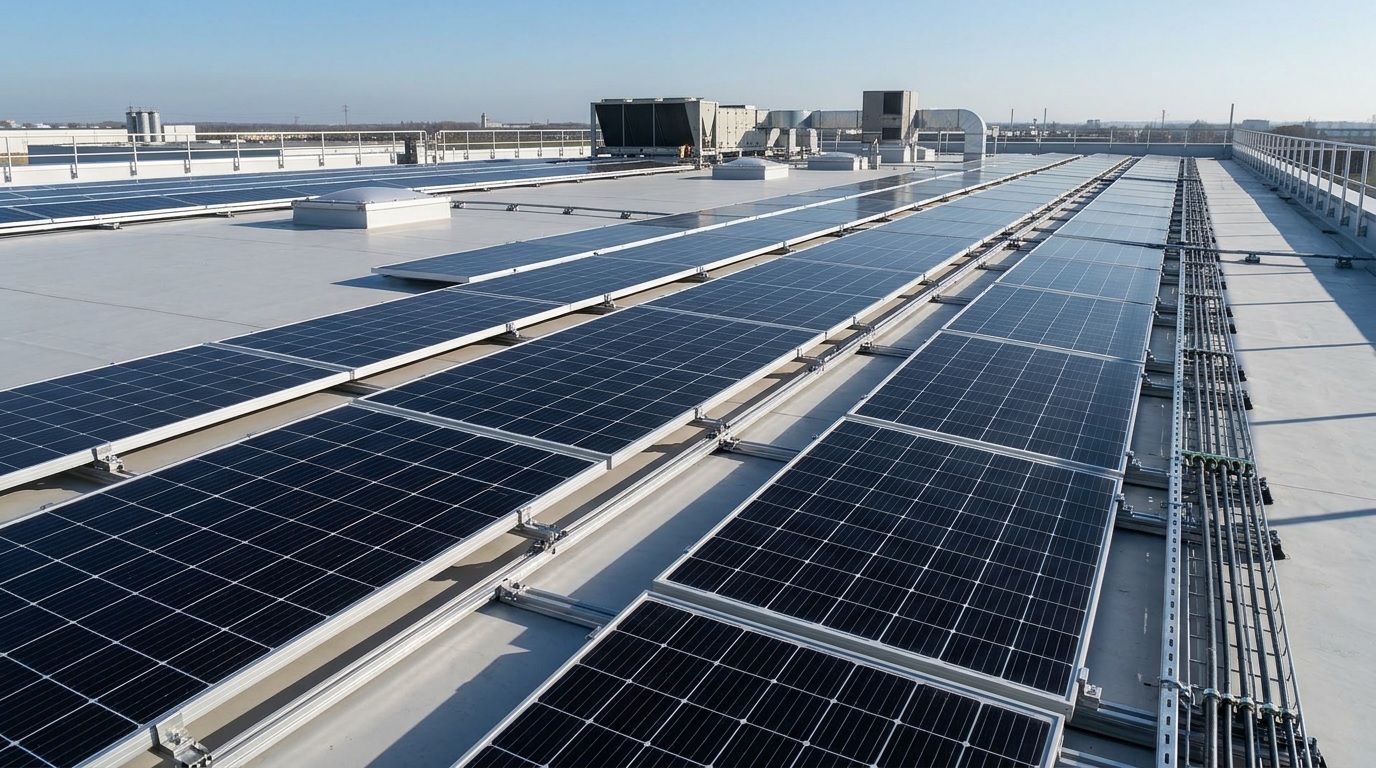
For commercial and industrial flat roofs, mid-to-large modules rated between 550W and 620W strike an effective middle ground. Flat commercial roofs offer unobstructed rectangular bays where 2.27-meter panels align cleanly on ballasted or mechanically attached racking, cutting per-watt mounting hardware and DC wiring costs without exceeding roof dead-load limits.
For utility-scale ground-mounted solar farms, ultra-high-power modules rated from 650W to 720W and above deliver clear economic advantages. Ground installations use heavy machinery for handling, accommodate wide tracker rows, and pair directly with high-current central or string inverters. Fewer modules per megawatt mean fewer foundation piles, shorter cable runs, fewer combiner boxes, and faster mechanical assembly across massive sites.
Frequently Asked Questions About Solar Panel Size and Power Output
Do bigger solar panels always generate more electricity per square meter?
No. A larger panel produces higher total wattage because it covers more area, but electricity generated per square meter depends on conversion efficiency rather than physical dimensions. Two panels with 22.5 percent efficiency produce the exact same power per square meter regardless of whether one is a 430W residential panel or a 660W commercial panel.
Why are 700W solar panels rarely installed on residential roofs?
Modules rated around 700W measure roughly 2.38 meters long by 1.30 meters wide and weigh 34 to 38 kilograms. Their size makes them difficult to maneuver safely on pitched roofs, leaves wasted gaps around vents and roof edges, and produces high operating currents that exceed the input limits of many residential inverters.
Is it better to buy fewer large solar panels or more compact high-efficiency panels?
On open land or large flat commercial roofs, fewer high-wattage panels lower racking, cabling, and installation labor costs per watt. On space-limited or complex residential roofs, a larger quantity of compact, high-efficiency panels usually fits the roof geometry better and yields higher total system capacity.
Does a larger solar panel require a different inverter?
Often, yes. Large-format panels built with 210mm cells generate higher operating currents than traditional residential modules. Inverters must be sized to handle both the string voltage and the higher maximum power current so the system avoids midday current clipping.
Need Technical Specs or Factory Pricing?
Talk directly with Homesun engineers for module datasheets and turnkey BOM proposals.